
For many people, ChatGPT feels a bit… underwhelming.
They try it once or twice, ask a few questions, get a generic answer, and walk away thinking, “It’s not that good.”
But here’s the truth: Most people don’t get great results from ChatGPT, not because the tool is limited, but because the instructions they give it are vague!!

ChatGPT is powerful — but it’s also literal. It responds to the quality, clarity, and structure of the prompt it receives. When the prompt is unclear, the output is also unclear. When the prompt is structured, the output becomes sharper, more relevant, and far more useful.
This post breaks down why beginners often achieve average results, how ChatGPT actually thinks in context, and how a few simple changes can significantly improve the quality of your outputs, so Let’s dive in.
The Real Problem: Vague Prompts Lead to Vague Answers
Most people talk to ChatGPT the way they talk to Google:
• “Write a blog post about productivity.”
• “Explain marketing.”
• “Give me ideas for my business.”
These prompts are too broad. They lack direction, purpose, and constraints. So ChatGPT does the only thing it can: it gives a broad, generic answer.
It’s not being “basic.”
It’s doing exactly what you asked.
Think of ChatGPT like a chef. If you walk into a kitchen and say:
You’ll get something edible — but probably not memorable.
If you say:
Now the chef can create something specific, intentional, and delicious.
Prompts work the same way.
Weak vs Strong Instructions (With Real Examples)

Let’s look at how small changes in your instructions can completely transform the output.
Example 1: Writing a Blog Post
Weak prompt:
“Write a blog post about digital marketing.”
What you’ll get:
A generic, surface-level article that sounds like every other blog on the internet.
Strong prompt:
Write a 1,000‑word beginner-friendly blog post about digital marketing for small business owners. Use simple language, short paragraphs, and clear subheadings. Include examples, avoid jargon, and end with a practical checklist.”
What you’ll get:
A structured, useful, audience‑specific article that feels intentional.
Example 2: Generating Ideas
Weak prompt:
“Give me business ideas.”
Strong prompt:
“Give me 10 business ideas for a solo creator who enjoys teaching, writing, and technology. Prioritize ideas that can be started with low cost and have potential for recurring revenue.”
Example 3: Asking for Advice
Weak prompt:
“How do I grow my audience?”
Strong prompt:
“I’m a beginner creating educational content for parents who want to teach digital literacy to their kids. Give me a step-by-step plan to grow my audience over the next 90 days using simple, low-cost strategies.”
Example 4: Improving Writing
Weak prompt:
“Make this better.”
Strong prompt:
“Rewrite this paragraph to sound clearer, more confident, and more conversational. Keep the meaning the same, but improve the flow.”
The difference is night and day.
Strong prompts provide ChatGPT with context, constraints, and direction — the three essential ingredients that transform average outputs into exceptional ones.

Why Clarity Matters More Than Creativity
People often assume that ChatGPT needs clever or poetic prompts.
It doesn’t.
It needs clarity.
Clarity tells the model:
• Who you’re speaking to
• What you want
• Why do you want it
• How it should be delivered
• What to avoid
• What success looks like
When ChatGPT knows these things, it can tailor the output with precision.
Here’s a simple formula you can use:
The 5‑Part Prompt Framework
1. Role — Who should ChatGPT act as?
2. Goal — What do you want to achieve?
3. Context — What background information matters?
4. Constraints — Word count, tone, format, audience
5. Examples — Optional, but extremely powerful
This framework works for everything: writing, planning, brainstorming, learning, coding, marketing, and more.

How ChatGPT Thinks in Context (And Why It Matters)!
ChatGPT doesn’t “think” like a human — but it does follow patterns.
It uses:
• The words you give it
• The structure you use
• The examples you provide
• The tone you set
• The context from earlier messages
This is why your first message sets the tone for everything that follows.
If you start vague, the conversation stays vague.
If you start structured, the conversation becomes structured.
ChatGPT is essentially a mirror. It reflects the clarity you bring into the prompt.
Context compounds
When you give ChatGPT context — your goals, your audience, your style — it builds on that information with every response.
This is why long, detailed prompts often outperform short ones.
You’re giving the model more “signal” and less “noise.”

Why Beginners Get Generic Answers
Beginners tend to get average results for a few predictable reasons:
They ask broad questions
ChatGPT responds with broad answers.
They don’t specify the audience
Without an audience, ChatGPT defaults to “everyone,” which leads to generic writing.
They don’t define the format
If you don’t say “give me steps,” “give me a script,” or “give me a table,” ChatGPT chooses a random structure.
They don’t set constraints
Word count, tone, examples, and style all shape the output.
They don’t iterate
Beginners accept the first answer.
Experts refine it.
They don’t give feedback
ChatGPT improves dramatically when you say:
- “Make it shorter.”
- “Make it more conversational.”
- “Give me more examples.”
- “Rewrite this for beginners.”
They don’t use role assignment
Telling ChatGPT who to be unlocks a different level of quality.
For example:
This instantly changes the tone, structure, and depth of the output.
The Fix: Use Structured Prompts That Guide the Model
If you want ChatGPT to produce high-quality work, you need to give it high-quality instructions.
Here’s a simple before-and-after transformation to illustrate the difference.
Before: Weak Prompt
“Explain SEO.”
After: Strong Prompt
“Explain SEO to a complete beginner using simple language and short paragraphs. Use real examples, avoid jargon, and include a 5‑step starter plan at the end.”
Before: Weak Prompt
“Write a sales email.”
After: Strong Prompt
“Write a friendly, non-pushy sales email promoting my free digital literacy guide for parents. Keep it under 150 words, use a warm tone, and end with a clear call-to-action.”
Before: Weak Prompt
“Give me ideas for my website.”
After: Strong Prompt
“Give me 10 homepage section ideas for a children’s digital literacy brand called ‘Learning with Chip.’ The tone should be warm, educational, and parent-friendly.”
These aren’t complicated prompts.
They’re simply clear.
And clarity is what unlocks ChatGPT’s full potential.
The Secret Skill: Prompt Building
Prompt building isn’t about being clever.
It’s about being intentional.
A great prompt:
- Sets direction
- Reduces ambiguity
- Gives ChatGPT a role
- Defines the audience
- Establishes the tone
- Clarifies the format
- States the goal
- Adds constraints
- Provides examples
When you combine these elements, ChatGPT becomes dramatically more useful — not because the model changed, but because your instructions did.
You Don’t Need to Be an Expert — You Just Need Better Prompts
Most people assume they need to “learn AI” or “understand how ChatGPT works.”
You don’t.
You just need to learn how to communicate with it clearly.
Think of ChatGPT as a highly capable assistant who:
- Never gets tired
- Never gets annoyed
- Never runs out of ideas
- Never forgets context
- Always follows instructions, but like any assistant, it performs best when you give it
- Clear goals
- Clear instructions
- Clear examples
Once you master this, ChatGPT becomes one of the most powerful tools you’ll ever use.

If you want to get consistently great results from ChatGPT the fastest way is to use structured prompts.
“So If you’d like a structured system that generates 10 personalised prompts for you, you must try our FREE Beginner Prompt Builder.”
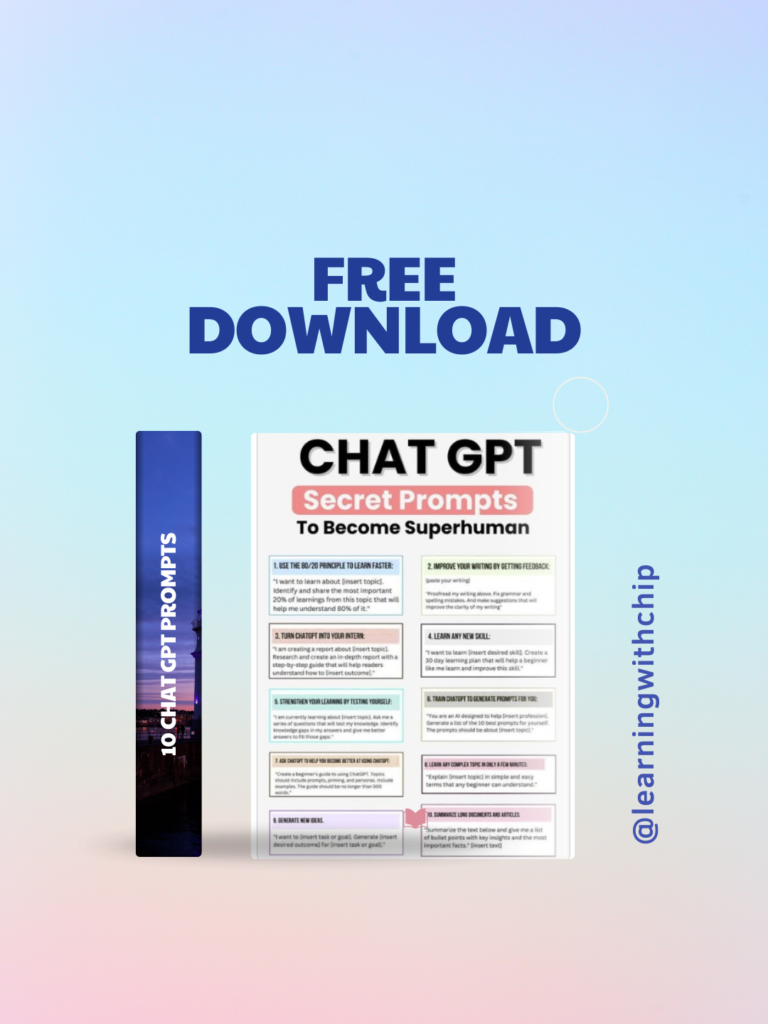
Download the 10 Free ChatGPT Prompt Builder
This template helps you:
- Write better content
- Generate better ideas
- Plan faster
- Learn quicker
- Communicate clearly
- And get dramatically better outputs
It’s simple, beginner-friendly, and designed to help you get the most out of ChatGPT — even if you’re never used it before.
